


























































































































































































































































































































-Digital-Training_11_08_2026_11_39_49.jpeg)










































World Wide Web Day: The Journey of the Digital Revolution from Tim Berners-Lee's Invention to the AI Era- Dr. Katheriya

ताजा खबरों से अपडेट रहने के लिए हमारे Whatsapp Channel को Join करें |
 World Wide Web Day
Explains the origin of the World Wide Web and Sir Tim Berners-Lee’s pioneering contribution.
Covers the evolution from Web 1.0 to AI-powered Web 3.0 and its impact on society.
Highlights the importance of digital literacy, cybersecurity, and ethical AI in the future of the web.
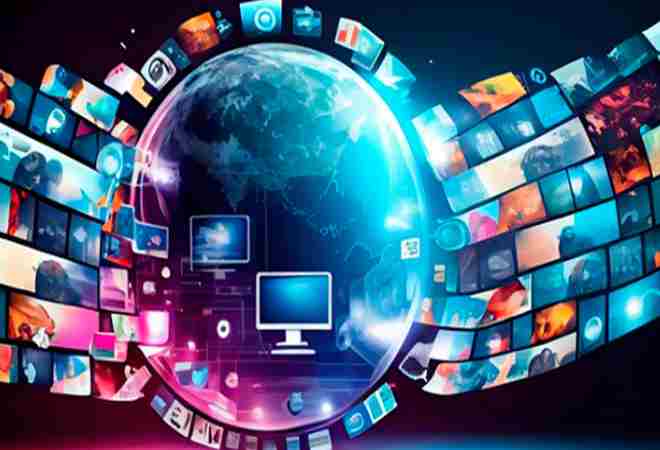
Nagpur / Every year on August 1, the world celebrates World Wide Web Day. It is an opportunity to remember the technological breakthrough that completely transformed the way people access information, learn, communicate, and connect with one another. Today, we study from home, manage our bank accounts, shop online, access government services, and consult doctors through digital platforms. From exploring career opportunities to finding life partners through matrimonial websites, the World Wide Web has become an integral part of modern life.
Today, nearly 6.1 billion people, about 74 percent of the world's population, use the Internet. More than 1.4 billion websites exist online, although only around 200 million are actively maintained. India has emerged as one of the world's largest internet-connected nations, with more than 1.24 billion internet users, reflecting the country's rapidly expanding digital ecosystem.
For many people who once struggled with loneliness or lacked opportunities to communicate, the Internet has opened entirely new ways of connecting with others. Online communities and social media platforms now provide not only communication but also emotional support and social engagement. At the heart of this transformation lies the World Wide Web (WWW). It is not merely a technology. It is the foundation of modern digital life.
Tim Berners-Lee and the Birth of the World Wide Web
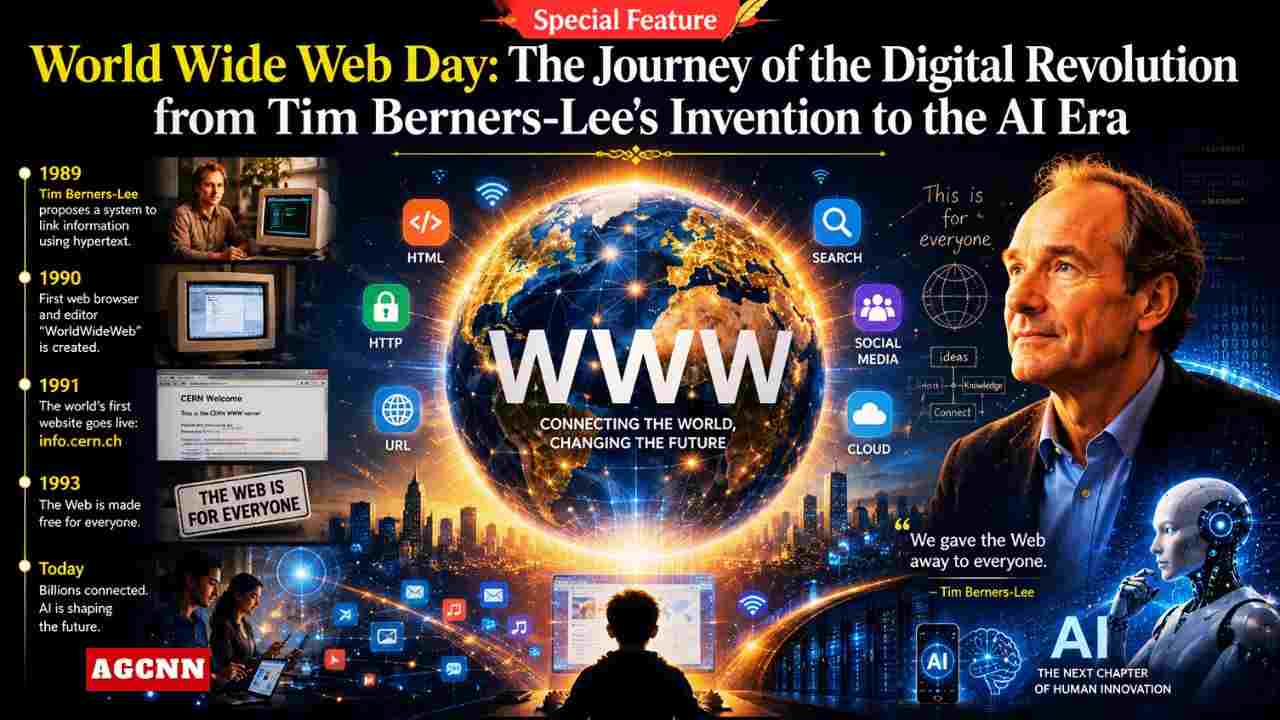
In 1989, British computer scientist Sir Tim Berners-Lee was working at the European Organization for Nuclear Research (CERN) in Switzerland. At that time, scientists around the world found it difficult to share information stored on different computer systems. To solve this problem, he proposed a system that connected documents through hyperlinks, allowing anyone to access and share information easily. This revolutionary idea became the foundation of the modern World Wide Web (WWW).
He later developed HTML (HyperText Markup Language), HTTP (HyperText Transfer Protocol), and URL (Uniform Resource Locator), the core technologies that continue to power every website today. In 1990, he created the world's first web browser and web editor, named WorldWideWeb. It was later renamed Nexus to avoid confusion with the Web itself. During the same period, he also developed the world's first web server. In 1991, the first website, info.cern.ch, went live, officially marking the beginning of the Web era. It still exists today as an important historical document.
Perhaps the most remarkable aspect of Berners-Lee's achievement was his decision not to keep the technology under private ownership. Instead, he chose to make it freely available to everyone. In 1993, CERN officially released the Web into the public domain, allowing anyone to use and develop it without paying licensing fees. Reflecting this philosophy, Berners-Lee once said: "We gave the Web away to everyone."
This visionary decision enabled the Web to grow rapidly, inspire innovation, and reach billions of people across the globe. The same philosophy was celebrated during the 2012 London Olympic Games Opening Ceremony, where his famous message appeared on giant screens:
"This is for everyone."
Later, he played a key role in establishing the World Wide Web Consortium (W3C), which continues to develop open web standards and ensures that the Web remains open, accessible, and beneficial for everyone.
What Is the Difference Between the Internet and the World Wide Web?
Many people use the terms Internet and World Wide Web interchangeably, although they are not the same.
Imagine the Internet as a vast network of highways connecting cities across the world. The World Wide Web is like the vehicles traveling on those highways, carrying information from one destination to another. Whenever we open a website through a browser, we are actually using the Internet to access the World Wide Web.
The Evolution of the Web: From Web 1.0 to the AI Era
Over the past three decades, the World Wide Web has evolved through several major stages.
Web 1.0, often called the "Read-Only Web," allowed users to read information but offered little opportunity for interaction or participation.
The arrival of Web 2.0 transformed the Web into a social and interactive platform. Services such as Facebook, YouTube, Wikipedia, blogs, and social media platforms enabled ordinary people to create and share content. Users were no longer passive consumers. They became active participants in the digital world.
The concept of Web 3.0 introduced a more intelligent Web, where machines attempt to understand not only words but also their context and meaning.
Today, the Web is entering a new era driven by Artificial Intelligence (AI). AI-powered search engines, chatbots, voice assistants, automatic translation, and personalized recommendations are making the Web smarter than ever before.
How Has the Web Changed Our Lives?
Today, the World Wide Web has become an inseparable part of everyday life. Online learning platforms and virtual classrooms have expanded educational opportunities. Telemedicine and digital healthcare services have brought doctors and patients closer together. Digital banking and online payment systems have made financial transactions faster, safer, and more convenient.
Government services have also undergone significant digital transformation. Obtaining certificates, paying taxes, and accessing public welfare schemes have become much easier than before.
The Web has also transformed social life. Social media and video calling have brought families and friends closer despite geographical distances. Matrimonial websites have simplified the search for life partners, while streaming platforms have revolutionized entertainment. Movies, music, sports, and news are now available with just a few clicks.
The COVID-19 pandemic clearly demonstrated the importance of the Web. Remote work, online education, and virtual meetings proved that the World Wide Web is not simply a convenience. It is a vital infrastructure that keeps society connected during difficult times.
The Future of the Web in the AI Era
In the coming years, the World Wide Web is expected to become even more intelligent, personalized, and user-centric. AI will better understand users' preferences, languages, and needs, delivering more accurate and customized information. Education, healthcare, agriculture, industry, and public services are expected to benefit significantly from AI-powered web technologies. Smart cities, autonomous transportation, digital governance, and scientific research will also rely increasingly on intelligent web systems.
Experts believe that the future Web will do far more than simply provide information. It will help solve problems, assist in decision-making, and connect intelligent devices to create seamless digital experiences. At the same time, privacy, transparency, cybersecurity, and the ethical use of AI will become more important than ever. The greatest challenge will not only be developing advanced technologies but also ensuring that they are used responsibly.
Digital Literacy: The Next Big Challenge in the AI Era
While the World Wide Web has created extraordinary opportunities, it has also introduced new challenges. Cybercrime, online fraud, cyberbullying, fake news, identity theft, and misinformation continue to grow rapidly. With the rapid advancement of Artificial Intelligence, identifying deepfake videos and AI-generated misleading content has become increasingly difficult. As technology becomes more powerful, using it safely and responsibly has become equally important.
Today, simply knowing how to use the Internet is no longer enough. People must also learn how to distinguish reliable information from misleading content. This is why digital literacy is becoming an essential life skill for every citizen. From children to senior citizens, every generation needs the knowledge and skills required to navigate the digital world safely.
In the years ahead, societies that embrace technology responsibly and ethically will benefit the most. Ultimately, the future belongs not only to those who create new technologies but also to those who understand them and use them wisely.
Today, the World Wide Web is far more than a collection of websites. It has become one of humanity's most powerful platforms for knowledge, innovation, education, commerce, and global communication. Sir Tim Berners-Lee's visionary idea connected the world, and today Artificial Intelligence is leading that vision into an entirely new era.
In the years ahead, the World Wide Web will become even smarter, faster, and more user-centric. However, its true success will depend not only on technological innovation but also on the responsible, ethical, and inclusive use of these technologies. World Wide Web Day reminds us that the ultimate purpose of technology is to improve human life by making it simpler, safer, and more connected. The future of our digital world will be only as secure and successful as the wisdom and responsibility with which we choose to use it.
About the Author
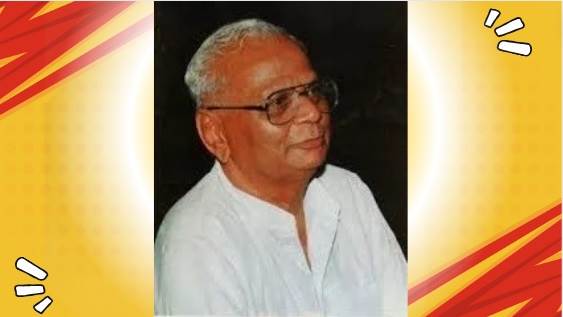
Dr. Dharvesh Katheriya
Associate Professor
Department of Mass Communication
Mahatma Gandhi Antarrashtriya Hindi Vishwavidyalaya
Wardha, Maharashtra, India
Email: [email protected]
1 August 2026


